Fire Damage Restoration FAQ — O'Fallon, MO
Straight answers to the questions O'Fallon homeowners ask most after a fire. If you are dealing with an active emergency, stop reading and call 911 — everything below is about the recovery that happens once that emergency is over.
Are you the fire department, or do you handle what comes after?
We are not the fire department, and we do not respond to active fires. If there are flames, heavy smoke, or any ongoing emergency, call 911 first — that is not a step to skip or delay. Our work is the recovery side: once the fire department has put the fire out and released the property to you, we handle board-up, soot and smoke cleanup, odor removal, and drying out the water used to fight the fire. Two different jobs, two different calls.
Is it safe to go back into my house after a fire?
Not always, and not automatically just because the fire is out. Heat can compromise structural framing without it being obvious, electrical systems can be damaged in ways you cannot see, and soot residue itself contains substances you do not want to breathe in a closed-up house. If the fire department or a building inspector has restricted access to the property, do not enter until that restriction is lifted. If you are unsure, treat the house as unsafe until someone can walk through it with you and confirm otherwise — floors, electrical, and air quality specifically.
What does homeowners insurance typically cover after a fire?
Most standard homeowners policies cover fire damage, including the structure, smoke damage, and the water damage caused by firefighting efforts, since all of it stems from a single covered event. What is covered in detail depends on your specific policy — dwelling coverage for the structure, personal property coverage for belongings, and often additional living expenses if the home is not livable during repairs. Arson and certain neglect-related causes can complicate a claim, which is one more reason accurate documentation from day one matters. Read your policy or call your agent early; do not assume based on what a neighbor's policy covered.
How long does fire damage restoration typically take?
It depends heavily on scope. A single room with smoke and soot damage but no structural loss might be cleaned, treated, and ready for repair work within a week or two. A fire that reached framing, the attic, or several rooms can take several weeks of fire damage restoration work before reconstruction even starts, and reconstruction itself can run for months on a serious loss. We can give a realistic timeline once we have actually seen the damage — anyone quoting a firm number before that is guessing.
Can smoke smell actually be removed, or does it just get covered up?
It can be fully removed in the large majority of cases, but it takes more than air freshener or a candle. Smoke odor lives inside porous materials — drywall, insulation, fabric, wood — not just in the air, so treating the air alone only masks it temporarily until the smell works its way back out. Real odor removal means cleaning or removing what absorbed the smoke, sealing surfaces that held onto it, and treating the space itself. Skipping steps to save time is why some homes still smell like smoke months after a fire.
What happens to wiring and electrical systems after a fire?
Any wiring, outlets, panels, or fixtures exposed to fire, heat, or firefighting water need to be evaluated before that area gets treated as safe to power up. Heat can degrade wire insulation without leaving obvious damage, and water intrusion into a panel or outlet is its own hazard. This is not a call we make alone — a licensed electrician typically inspects anything the fire or water reached before it gets reconnected or repaired. Do not assume power is safe in a fire-damaged area just because the lights still turn on.
How much does fire damage restoration typically cost?
The range is wide because fire severity is wide. A contained incident limited to smoke and odor damage in one or two rooms often runs a few thousand dollars. A fire that damaged framing, multiple rooms, or a full level of the house typically moves into five figures once cleanup, drying, and repair coordination are combined, and a major structure fire can run considerably higher. Board-up and tarping alone are comparatively inexpensive — usually a few hundred to around a thousand dollars depending on how much of the structure needs to be secured. We give real numbers after seeing the damage, and for a covered loss your direct cost is often limited to your deductible.
How soon should a fire-damaged house be boarded up or tarped?
Same day, if at all possible. Once the fire department clears the property, a broken window, a burned-through door, or an open section of roof is doing damage on its own — rain gets in, temperatures swing, and an unsecured house draws attention from anyone passing by. Board-up and roof tarping are usually the very first job on a fire recovery, ahead of any cleaning, because everything else depends on the structure being closed up and protected first.
What happens to furniture, clothing, and other belongings?
It depends on what they are and how much exposure they had. Many textiles — clothing, some upholstery, some linens — can be professionally cleaned and deodorized rather than replaced, particularly if the exposure was smoke rather than direct flame or heavy water. Hard-surface items like some furniture, electronics, and kitchenware can sometimes be cleaned of soot and odor as well. Items with direct fire or heat damage, or heavy water saturation, are usually a loss. A methodical inventory — what stays, what goes, what gets professionally cleaned — protects both your recovery and your insurance claim.
Is soot dangerous to touch or breathe?
Treat it as something you do not want on your skin or in your lungs, especially in any quantity or in an enclosed space. Soot from a house fire is not just carbon — it carries whatever burned, which in a modern home includes plastics, synthetic fabrics, and treated materials that leave a residue you should not handle bare-handed or breathe without protection. Keep kids and pets away from soot-covered areas, avoid dry-dusting or vacuuming it with a household vacuum (that just puts fine particles into the air), and let a proper soot cleanup process handle it with the right equipment for the surface it is on.
What should I do in the first hour after firefighters clear the scene?
Confirm with the fire department or an inspector that it is actually safe to go back in before you do. Do not turn on power or gas to any area the fire reached until each has been checked. Photograph and video everything before anything gets moved, cleaned, or thrown away — the damage, the water, the debris, all of it. Call your insurance company to open a claim. Get the property secured — boarded windows, tarped roof — the same day if you can. And do not run the HVAC system if smoke or heavy soot reached the ductwork; that spreads it through the whole house.
What typically causes house fires in O'Fallon?
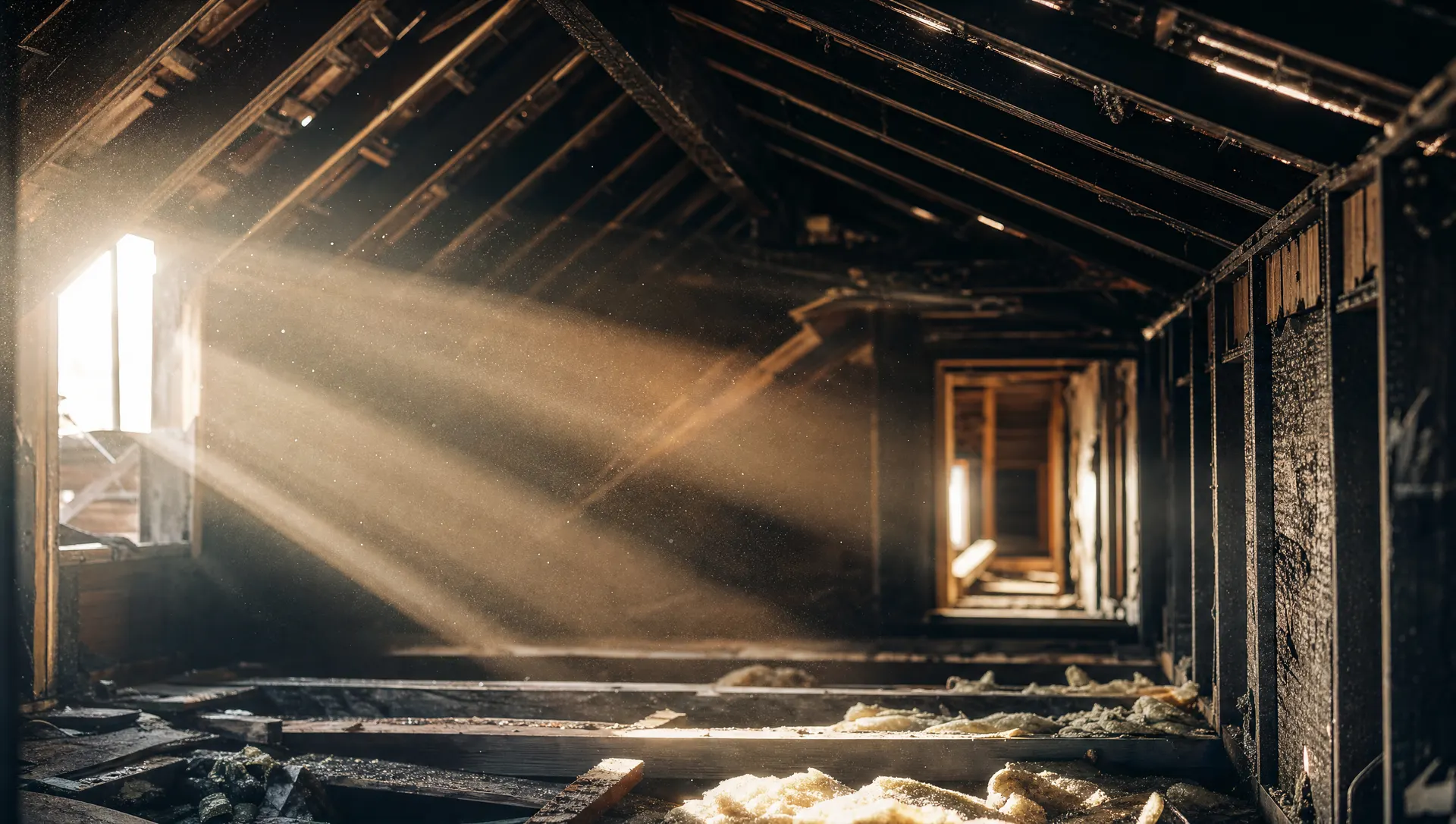
A few patterns show up repeatedly in a city built mostly of 1990s-to-2010s subdivision homes with attached garages. Garage fires are common — a parked vehicle, stored fuel, a workshop or freezer wired in after the house was built — and a garage fire can move into the attic and spread across the roof structure before it is ever noticed from inside the house. Winter brings space heaters placed too close to bedding, curtains, or furniture. The holiday season adds grease and cooking fires along with the extra electrical load of holiday lighting. None of that is unique to O'Fallon, but it is the shape fire damage tends to take across the area's subdivisions.
Will you work directly with my insurance adjuster?
Yes. We document the damage, the work performed, and the materials affected in a way built to support a claim, and we can speak directly with your adjuster about the scope of the restoration work. You are still the one who opens the claim and manages the policy relationship — we are not your insurance company — but we make sure the adjuster has what they need from the restoration side without you having to relay every detail yourself.
What areas do you serve?
O'Fallon and the surrounding St. Charles County area, including St. Peters, St. Charles, Lake St. Louis, Wentzville, Dardenne Prairie, and Cottleville. If a fire touched a property anywhere in that area, reach out and we will get the recovery moving.
Get Help Now
If the fire department has released your property, the cleanup clock is already running — smoke smell and soot residue only get harder to deal with the longer they sit. Tell us what happened and we will help you get the recovery started.
Need Help in O'Fallon Right Now?
Tell us what you need and we'll get back to you fast with a free, no-pressure quote.